 HERITAGES
-

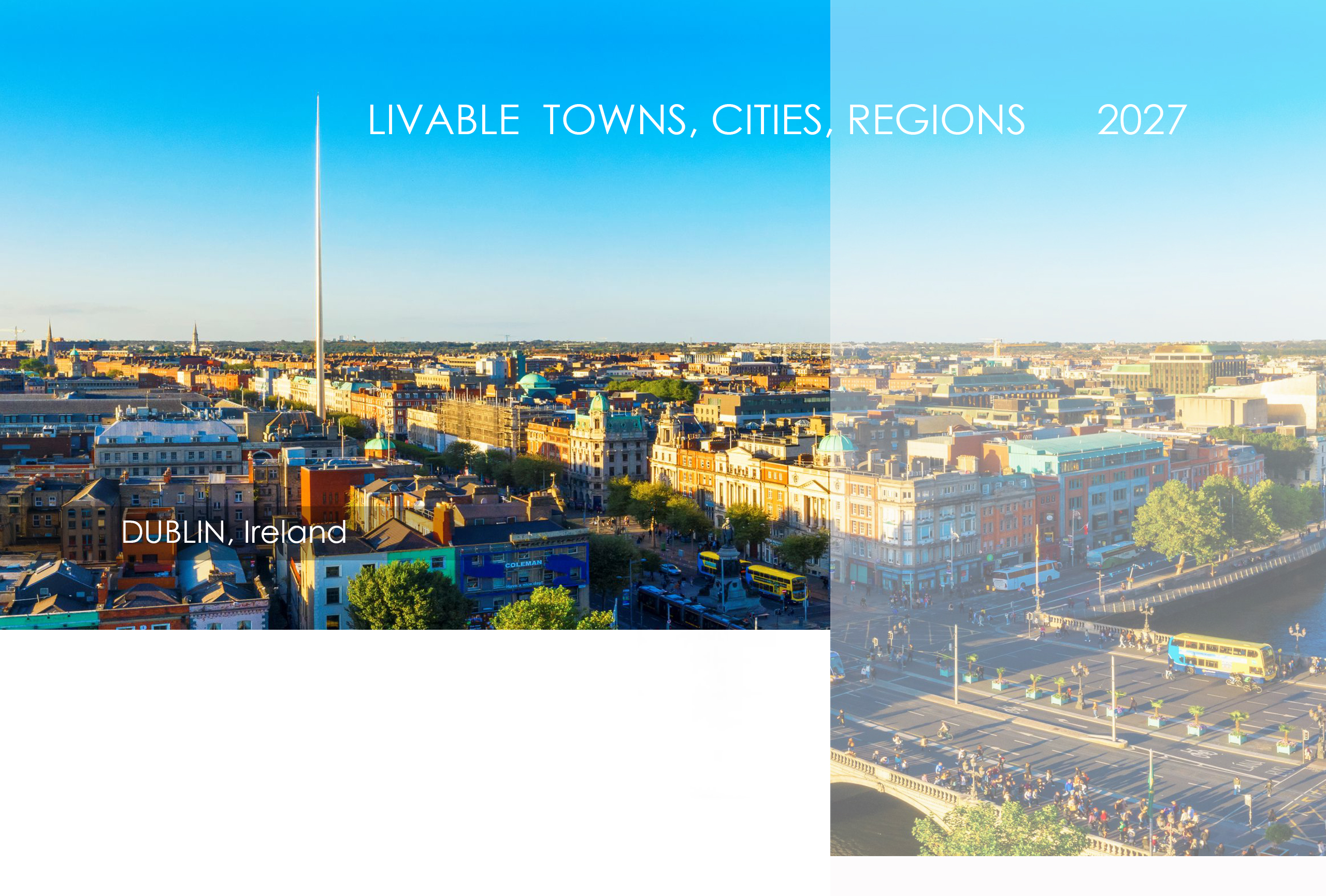
Livable Towns, Cities, Regions 2027 | Dublin, Ireland
A conference on the Future of Place, Planning, Communities & Design.
Dates: 28-30 June, 2026 | Abstracts: 5 Dec, 2026
Heritages – from the Built to the Social
Livable Towns, Cities, Regions 2027 is part of the international and interdisciplinary conference and publication series led by AMPS. Bringing together universities and scholars globally, it examines diverse readings of the history, culture, design, management and experience of life in cities. Previous conferences in have been held in New York, London, Bangalore, Lisbon, Barcelona, Calgary and elsewhere. The 2026 annual conference is organised with the University of Salford, Manchester, UK. It is subtitled ‘Critiquing the Urban Renaissance’.
Examining issues related to the heritage and culture this highlight notice welcomes submissions from a variety of fields including, but not limited to:
ART HISTORY | SOCIAL HISTORY | CULTURAL STUDIES | ARCHITECTURE & URBAN HISTORY | ANTHROPOLOGY | CONSERVATION | HERITAGE STUDIES | MUSEOLOGY | PRESERVATION STUDIES | COMMUNITY & REGIONAL HISTORY and more.

Call Summary
Towns, cities and regions around the world are confronting profound environmental, social and spatial transformation. Population growth, housing pressures and infrastructural demands are reshaping how our built environments are envisaged, developed and governed. Climate change, sustainability and resilience are reframing how we think about the future of design and planning. In their turn, our existing urban fabrics, inherited buildings and historic neighbourhoods, shape the possibilities of change.
In this context, when we design, preserve and plan the places in which we live, we are dealing with an increasingly complex and interconnected problem. Whether it be conservation, planning or architecture, or questions of communities, health and climate change, the terrain on which we tread inevitably overlaps.
The challenge in this scenario then, is not simply to preserve the past, design the present and plan a sustainable future, but to do it unison. For example, the reuse of existing buildings is central to carbon reduction; the participation of communities in design is key to urban planning; the adaptation of cities to digital infrastructures supports resilience and sustainability. It is a scenario that requires the skills of architects, planners, environmental scientists and technologists; the perspective of historians, sociologists and health professionals; and the knowledge and insights of local people and communities.
With all this in mind, the 17th Annual Conference in this series explores the design, management and experience of life in cities from across the full range of social science disciplines including:
Art & Architectural History, Archeology, Cultural Studies, the Humanities broadly understood, and more.

Themes
Interdisciplinary:
Tangible & Intangible Heritage: Example themes: Art & architectural history, Community & social pasts, museology, conservation & preservation, heritage studies….
Cultural Studies & the Humanities: Example themes: Cultural traditions, Intergenerational histories, Diasporas & heritage, Intangible heritage preservation….
Architecture, Landscape, Urban Design: Example themes: Architectural design, landscapes and cities, urban design, retrofitting and renovating buildings, public space design, walkable cities….
Technologies + Medias: Example themes: Smart Cities, digital infrastructures, the internet of things, digital equality, privacy and connectedness, ubiquitous computing, big data and city spaces….
Sociology, Geography, Anthropology: Example themes: affordable housing, community sustainability, participatory planning, migration, urbanization, forced displacement, cultural traditions….
Public Services: Example themes: Community health services, housing provision, access to education, sanitation and environmental health, design and planning for an aging population….
Urban Economics: Example themes: City boosterism, enterprise zones, global cities, affordable housing, urban poverty, urban regeneration, private-public partnerships, development….
Societies, Communities, Cultures: Example themes: Right to the city, race and the city, defensible space, criminology, gentrification, participatory planning, land rights, indigenous communities….
Livable Towns, Cities, Regions
Research + Publication Program
This conference is part of the AMPS Critical Futures research program that encompasses a range of interconnected issues, from architectural history, heritage and cultural studies to urban design, sociology and sustainability. In each of these areas AMPS supports the research of academics focused on issues that range from art history, architectural conservation and preservation to contemporary design, healthy cities and accessibility.
Overview:
Heritage – Critical Futures is concerned with exploring the interplay of tangible and intangible heritage with particular interest in placed based study. Cities – Critical Futures reflects the UN World Urbanization Prospects engaging with concerns about growing urbanisation, informal development, urban sprawl, regeneration and the future of post-industrial cities across Europe and North America. Health – Critical Futures engages with global issues such as the historic link between housing conditions and the public health movement, healthy cities, accessible design, design for life, Covid-19 and public spaces, ‘sick building’ research and more. Housing – Critical Futures responds to a global ‘crisis’ in affordable housing provision. It examines dichotomies such as the chronic shortage of affordable housing in London, the displacement of long-standing communities in urbanising China and civil unrest around housing in São Paulo.
Previous & Current Collaborations:
The Royal Institute of British Architects, UNESCO World Heritage Site of Maritime Greenwich, The Royal Parks, FACT, The UN Habitat Program, The Commission of Architecture and the Built Environment, The Faculty of Public Health, UCL Press, Libri Publishing, Vernon Press, Cambridge Scholars Publishing, Atelier Herman Hertzberger, The National Housing Federation, the Pubic Health Film Society, the homelessness charity Shelter, Habitat for Humanity and multiple universities internationally.
Publications
Books, Journal, Proceedings
The Critical Futures program draws upon the AMPS publication network based on the journal and book series with several international publishing houses: Routledge Taylor & Francis | UCL Press | Intellect Books | Libri Publishing | Vernon Press | Cambridge Scholars Publishing.
In addition the work of researchers is shared through the Amps Academic YouTube channel, its series of international conferences and its associated proceedings publications.
Sample Books
- Museums – Places of People, Time, and Memory: An Exploration of the Intersection of Place and History. (ed) Jitka Cirklová. Cambridge Scholars Publishing, 2025
- The Space of Image: Architectural Experience through Media. (eds) Gul Kacmaz Erk, Nic Theo, June Jordaan. Intellect Books, 2024
- Narrating the City: Mediated Representations of Architecture, Urban Form and Social Life. (ed) Ayşegül Akçay Kavakoğlu. Intellect Books, 2023
- Urban Histories in Practice: Morphologies and Memory. (eds) Jeffrey Kruth & Steven Rugare, Cambridge Scholars Publishing, 2021
- The Complex City: Social and Built Approaches and Methods. (ed) Caroline Donnellan. Vernon Press, 2021
- Critical Practices in Architecture: The Unexamined. (eds) Jon Bean, Susannah Dickinson, Aletheia Ida. Cambridge Scholars Publishing, 2020
- Designing for Health & Wellbeing: Home, City, Society. (eds) Matthew Jones, Louis Rice, Fidel Meraz. Vernon Press, 2019
- From Conflict to Inclusion in Housing . (eds) Graham Cairns, Georgios Artopoulos, Kirsten Day. UCL Press, 2017
- Housing the Future – Alternative Approaches for Tomorrow. (eds) Rachel Isaac-Menard and Graham Potts. Libri Publishing, 2016
- Design for a Complex World: Challenges in Practice and Education. (ed) Graham Cairns. Libri Publishing, 2015
Sample Journal Special Issues
- Human Relationships Embedded in Place. Architecture_MPS, ISSN 2050-9006. Vol 30 Nos.1-4. 2025
- War, Conflict & Memorialisation. Architecture_MPS ISSN 2050-9006. Vol 29 Nos.1-4. 2024
- Histories of Health. Architecture_MPS ISSN, 2050-9006. Vol 24 Nos.1-4. 2023
- Decolonising the Curriculum. Architecture_MPS ISSN, 2050-9006. Vol 21 Nos.1-4. 2022
- Art, Space and Activism. Architecture_MPS ISSN, 2050-9006. Vol 20 Nos.1-4. 2021
- Re-Design Teaching Design. Architecture_MPS ISSN, 2050-9006. Vol 18 Nos.1-4. 2020.
.
Sample Conferences
- Heritages – London 2025. London. University of Greenwich. 27-29 June, 2025
Urban Futures – Cultural Pasts. Barcelona. Universitat Politècnica de Catalunya. 15-17 July, 2024 - Local Culture – Global Spaces. Virtual. University of Melbourne, Louisiana State University, Chinese University of Hong Kong. 05-07 Dec, 2023
- Heritages – Prague. Czech Republic. Czech Technical University. 28-30 June, 2023
- Representing Pasts – Visioning Futures. Virtual. Queen’s University Belfast | Cape Peninsula University of Technology | National University of Singapore, 1-3 Dec. 2022
- Intangible Heritages. University of Kent. Canterbury. 15-17 June, 2022
- Connections: Heritage, Architecture, Cities. University of Kent. Canterbury. 28-30 June, 2020
- Tangible-Intangible Heritage(s). University of East London. 13-15 June, 2018
Books | Journal | Proceedings | YouTube | Conferences
Abstract Submissions
Click the button below to submit your abstract.
Fee: $415 USD – Queries: info@amps-research.com